
Why Custom Software Is Becoming Essential for Growing Businesses
Growing businesses cannot depend forever on spreadsheets, disconnected tools, and manual workflows. Custom software helps companies centralize operations, automate repetitive tasks, improve reporting, and build systems that match their real business process.
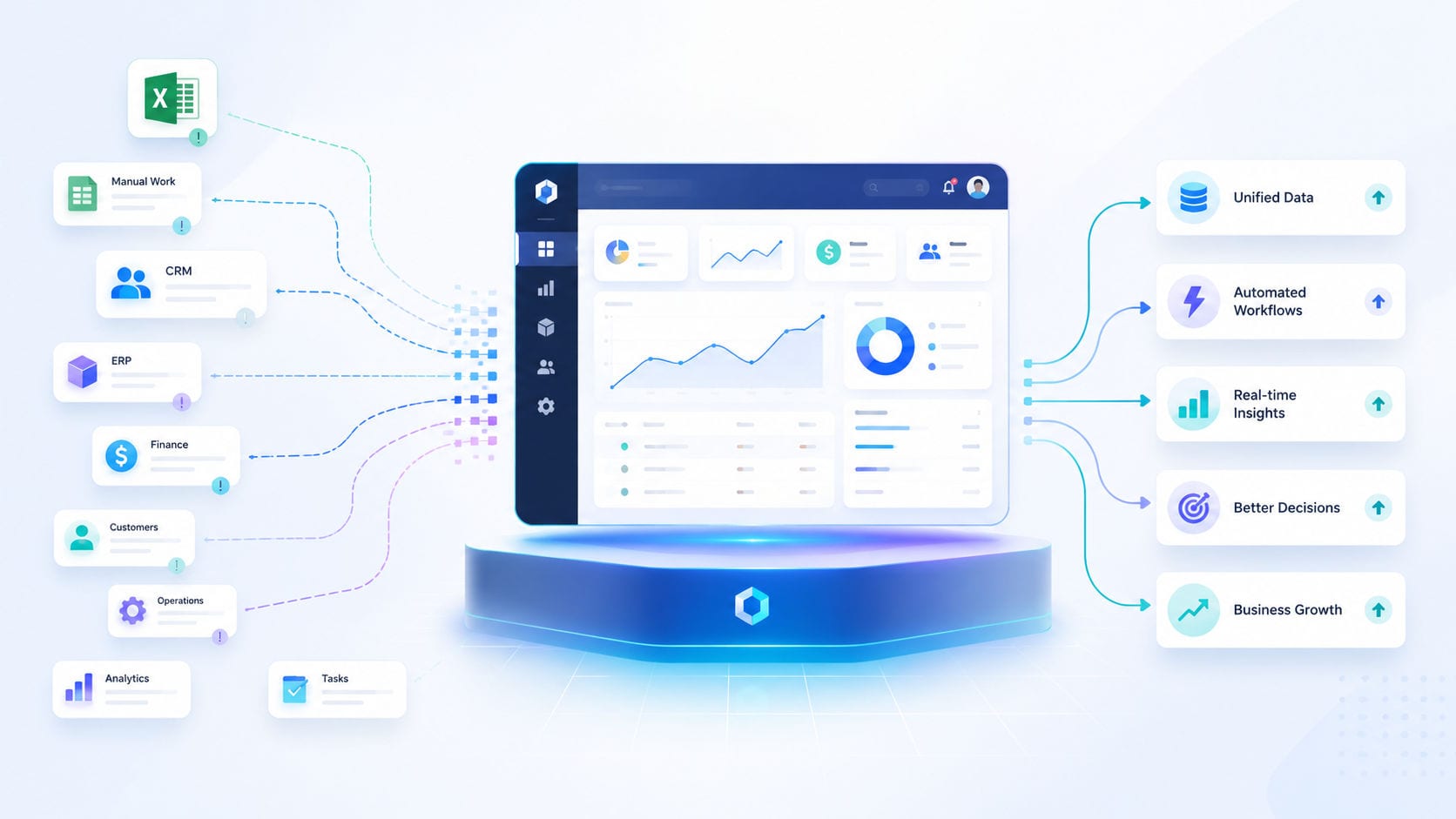
For growing businesses, efficiency is the difference between scaling successfully and hitting an operational wall. In the early stages of growth, relying on generic SaaS applications, scattered spreadsheets, manual invoicing, and disconnected messaging tools is normal. However, as transaction volumes increase and teams expand, this fragmented setup turns into a major source of friction.
Every manual data entry, missed follow-up, and slow client communication represents a direct leak in your company's profit margin.
Custom software development is the cure for this operational friction. By building a platform tailored specifically to your workflows, you can automate repetitive tasks, unify scattered data, and create a scalable digital foundation that grows alongside your business.
1. The Operational Bottleneck of Generic Software (The "SaaS Trap")
Many business owners believe that buying subscriptions to multiple SaaS tools (e.g., HubSpot, Trello, Mailchimp, QuickBooks) is the fastest way to digitize. While these tools are good individually, they create a highly fragmented ecosystem when used together:
The Integration Gap: Disconnected tools do not share data naturally. Staff must manually copy client info, contract details, and payments between platforms, leading to data entry errors and delays.
Feature Bloat: Off-the-shelf software is designed to serve every industry. As a result, you pay for a complicated user interface where your team only uses 10% of the features while the other 90% creates visual clutter and confusion.
Pricing Inflation: SaaS tools charge monthly subscription fees per user. As your team grows, your software overhead increases exponentially, eating into your operating margins.
Custom software bypasses these limitations by providing a clean, focused system containing only the features your business needs, with zero per-user licensing fees.
2. The Core Strategic Options: Custom Software vs. Packaged SaaS
Choosing your software strategy is a critical long-term decision. Here is a direct comparison of how custom-engineered platforms compare to generic SaaS subscriptions:
Option 1: Generic SaaS Subscriptions
Workflow Alignment: Rigid. Your team must change their daily processes to fit the software's preset templates.
Financial Model: Continuous, inflating monthly subscription fees based on the number of users.
Data Control: Your business data is stored on third-party servers, limiting your data privacy and control.
Integrations: Relies on third-party connectors (like Zapier) which can break when APIs update.
Scalability: Limited to the vendor's roadmap. You cannot build custom features as your needs evolve.
Option 2: Custom-Engineered Platforms (Motive Solutions)
Workflow Alignment: Perfect. The software is built specifically around your existing, proven workflows.
Financial Model: One-time development investment. Zero per-user monthly licensing fees—you own the codebase.
Data Control: Absolute. Your data is hosted on your own secure, private cloud servers.
Integrations: Native. Custom API integrations are built directly into the system's core architecture.
Scalability: Infinite. You can build, expand, and modify modules modularly as your business scales.
3. The Core Modules of a Centralized Business System
A custom-built business platform acts as a central operating hub, replacing multiple disconnected applications with one unified workflow:
A. Automated Ingestion & Pipeline Control
Manual sales tracking leads to missed opportunities. A custom platform automates the intake pipeline:
Automated Ingestion: Capturing leads from web forms, ads, and phone logs, and routing them to the correct sales rep instantly.
Status Tracking: Visualizing deals through custom sales stages (e.g., Inquiry, System Design, Proposal, Signed).
Alert Triggers: Nudging sales reps automatically when a high-priority lead has been left uncontacted.
B. Connected Billing & Finance
Connecting your sales dashboard to your financial module cuts invoice cycle times to zero:
Instant Invoicing: PDF invoices are automatically generated, logged in your accounting ledger, and sent to clients the second a deal is closed.
Payment Reminders: The system monitors invoice due dates and automatically emails polite, scheduled reminders to clients.
C. Live Operations & Dispatch Control
Unifying task tracking with employee availability ensures work is delivered on time:
Smart Resource Assignment: Routing tasks automatically based on team workloads and specialized skillsets.
Milestone Alerts: Alerting managers immediately when a B2B project is nearing its SLA deadline.
Learn how we build custom platforms in Custom Web Platforms.
4. The Step-by-Step Custom Software Lifecycle
Developing custom software requires a structured approach to ensure the system is secure, stable, and highly functional:
Operational Process Audit: We analyze your current daily workflows, identify manual bottlenecks, and map out your system requirements.
Database Schema Design: We build a clean, secure database structure that connects customer records, sales pipelines, billing, and inventories.
Module Development & API Construction: We build the system step-by-step, starting with your highest-priority workflow (e.g., billing automation or customer portals).
Data Migration: We securely transfer your legacy client records and data from old spreadsheets into the new database.
Team Training & Launch: We run onboarding sessions for your staff and collect feedback to continuously refine the user interface.
5. Security & Data Sovereignty
As your business grows, securing customer data and protecting your digital infrastructure becomes a priority. Custom software provides complete control over your security protocols:
Role-Based Access Control (RBAC): Restricting data views so staff members only see the information required for their specific job.
Private Databases: Storing your customer files on your own secure cloud servers (like AWS or Google Cloud) instead of third-party platforms.
API Protection: Implementing secure authentication protocols (like OAuth2 and JWT) to protect your data connections.
Explore our backend capabilities in Backend & API Development.
❓ Frequently Asked Questions: Custom Software
1. Isn't custom software much more expensive than ready-made SaaS?
While custom software requires a higher upfront development investment, it is far more cost-effective in the long run. Ready-made SaaS platforms charge per-user monthly subscription fees. If you have 20 employees and pay 50/monthperuserforthreedifferenttools,youarespending∗∗50/monthperuserforthreedifferenttools,youarespending∗∗36,000 annually** on software you do not own. Custom software has zero per-user licensing fees—saving you thousands of dollars as your team scales.
2. Can we build our custom platform in phases?
Yes. We highly recommend a modular approach. Instead of building your entire business system at once, we start with a Minimum Viable Product (MVP) that automates your single largest bottleneck. Once that module is running stably, we build and connect additional modules over time.
3. How do we move our data from Excel spreadsheets into the new software?
We handle the entire data migration process. We clean your legacy Excel/CSV sheets, map the fields to your new database schema, and run automated verification scripts to ensure no data is lost or corrupted during the transition.
4. Will we be locked into one software developer forever?
No. Because we write clean, standardized code (using popular frameworks like Next.js and Node.js) and provide complete documentation, any qualified developer can manage, update, or expand the system in the future. You have complete ownership of the code.
Build Your Scalable Digital Infrastructure
If your business is growing, continuing to run operations on scattered spreadsheets and disconnected apps is a high-risk strategy. To scale professionally and protect your operating margins, you need a unified system.
Custom software is the hidden engine that turns daily business complexity into organized, automated growth.
Let's map out your custom system. Draft your software requirements with our product team through our Guided Discovery Intake or get in touch directly at Motive Solutions Contact.