
What Makes a SaaS Product Scalable and Ready for Growth
A scalable SaaS product needs more than a good idea. It requires strong UI/UX, secure user accounts, subscription management, role-based access, reliable backend architecture, APIs, analytics, and long-term technical planning.
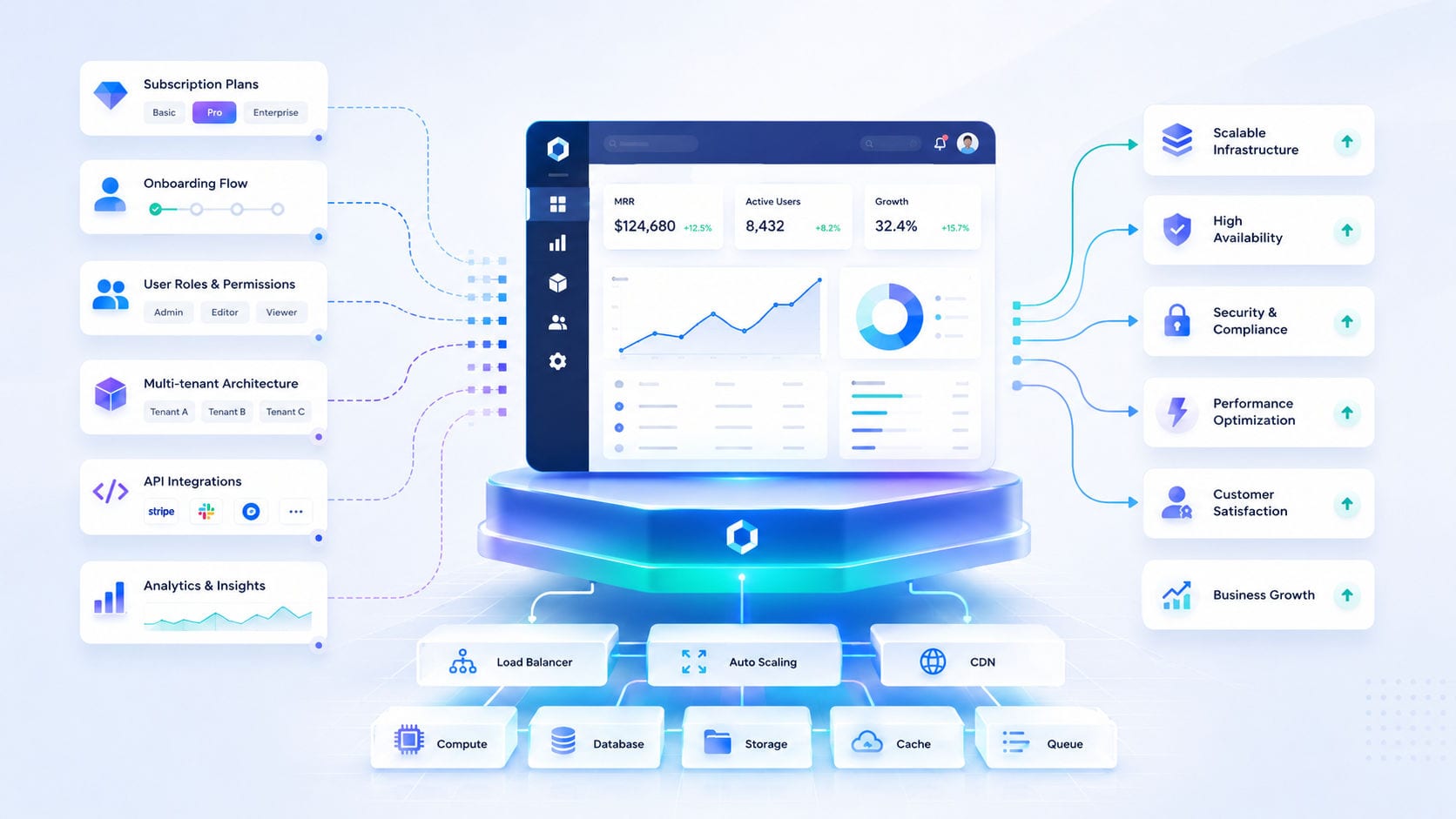
Many founders initiate a SaaS product with a strong vision, but transforming that vision into a platform capable of handling enterprise-level scaling requires architectural discipline. A growth-ready SaaS platform demands a highly secure backend, intuitive user onboarding, seamless subscription handling, and a database structure designed to scale without performance bottlenecks.
Building a scalable SaaS product is not just about launching features; it is about building a system that remains fast, secure, and flexible as your user base grows from a few dozen early adopters to thousands of active businesses.
1. Establishing a Solid System Foundation
The biggest threat to a scaling SaaS is "feature creep"—building too many elements too quickly without refining the core product. Before writing a single line of code, the system’s architecture must be mapped out.
Core Problem Focus: Defining the exact operational bottleneck you are solving.
Role Map: Detailing user roles (e.g., Admins, Managers, Customers) and data boundaries.
MVP Blueprint: Planning a Minimum Viable Product that focuses on solving the primary problem first, reducing development risk and speed-to-market.
Learn more about how we design Custom B2B Web Platforms.
2. Intuitive UI/UX and Frictionless Onboarding
If a SaaS dashboard is confusing, users will churn before they discover the product's value. The user interface must be clean, spacious, and responsive.
Self-Serve Onboarding: Simple steps that guide users to their first "Aha!" moment without requiring manual support.
Executive Dashboards: Presenting data using clear visual layouts and scannable KPIs.
Responsive Performance: Ensuring the platform runs identically on mobile, tablet, and desktop viewports.
3. Secure User Management & Multi-Tenant Access
For B2B SaaS platforms, security and organization-level data isolation are critical. You must ensure that Tenant A can never access the data of Tenant B.
Role-Based Access Control (RBAC): Fine-grained permissions that restrict actions based on a user's role.
Secure Authentication: Implementation of Multi-Factor Authentication (MFA), Single Sign-On (SSO), and secure session management.
Audit Logs: Keeping track of system modifications for B2B compliance.
4. Automated Subscription and Billing Infrastructures
A professional SaaS platform requires a billing system that handles recurring revenue models automatically without manual accounting.
Multi-Tiered Pricing: Supporting monthly plans, yearly commitments, and custom enterprise tiers.
Automated Billing Events: Handling upgrades, downgrades, cancellations, and card failures.
Merchant Integrations: Setting up secure payment gateways (like Stripe) that generate automated invoices and track subscription statuses.
5. High-Performance Backend & Database Architecture
Behind every great SaaS product is a high-performance backend. Poor backend planning is the primary cause of system crashes when user volume spikes.
API First Design: Building clean, RESTful or GraphQL APIs that connect your frontend to database models.
Database Scaling: Designing optimized database queries and caching layers (like Redis) to handle millions of reads.
Horizontal Scaling: Ensuring your servers can scale resources automatically to match user demand.
Explore our backend capabilities in Backend & API Development.
6. Embedded Product Analytics & BI Dashboards
Product owners need to make decisions based on real user data. Custom analytics tell you exactly how users behave, allowing you to improve the product.
Growth Metrics: Tracking Monthly Recurring Revenue (MRR), Customer Acquisition Cost (CAC), and Churn Rates.
User Engagement: Monitoring feature usage to identify which parts of the SaaS deliver the most value.
Funnel Conversion: Finding where users drop off during onboarding or upgrade screens.
Designing for Long-Term Platform Expansion
A successful SaaS is never finished; it is an ongoing journey of optimization. Designing the database and backend with growth in mind ensures you can introduce new automation modules, third-party integrations, and new features easily without breaking existing workflows.
With the right engineering foundation, a SaaS idea is transformed into a stable, highly scalable, and profitable digital asset.
Ready to build a B2B SaaS platform designed for enterprise growth? Let’s design your product architecture through our Guided Discovery Intake or consult our product engineering team at Motive Solutions Contact.