
REST API vs GraphQL: Which Is Better for Your Software Product?
Compare REST API and GraphQL based on performance, flexibility, development complexity, caching, security, scalability and suitability for web, mobile and enterprise software.
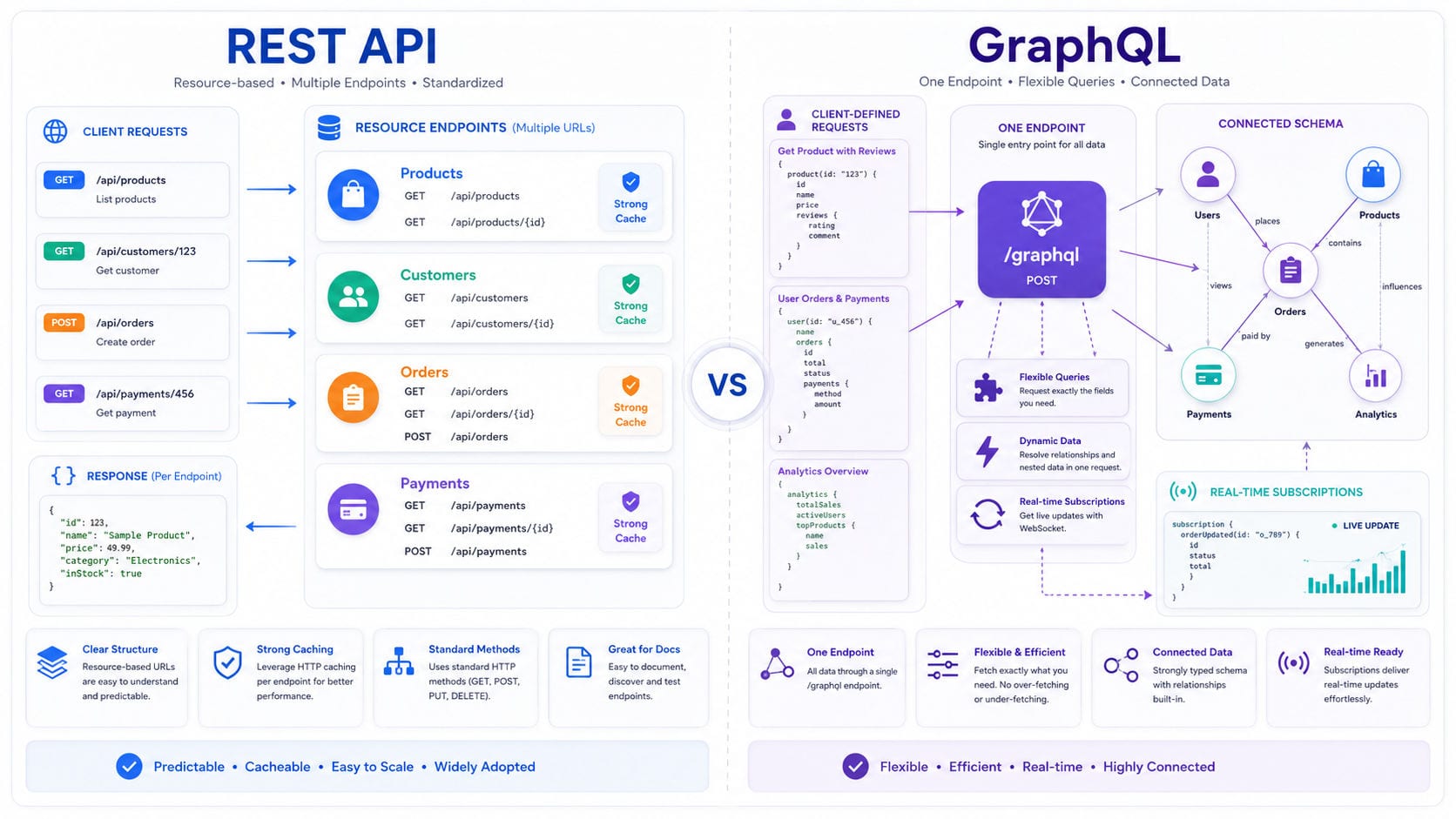
REST API vs. GraphQL: Which Is Better for Your Software Product?
APIs (Application Programming Interfaces) serve as the connective tissue of modern digital ecosystems, allowing websites, mobile applications, administrative portals, and third-party platforms to exchange information through structured, reliable protocols.
When designing a modern software architecture, engineering and product leaders typically evaluate two core methodologies:
REST API (Representational State Transfer)
GraphQL API
REST is a mature, widely adopted architectural style that organizes data and actions around multiple resource-specific endpoints. GraphQL is a query language and runtime that provides a query-based interface, enabling clients to request specific data points through a single API gateway.
Both approaches support secure, scalable, and high-performing software platforms. The optimal choice depends on your product architecture, database relationships, client-side requirements, engineering capabilities, security models, and long-term systems integration strategy.
To determine the right fit for your enterprise systems, explore our professional backend and API development services, where we align software architecture with business goals.
What Is a REST API?
REST (Representational State Transfer) is an architectural style that organizes application data into logical resources, each accessed via a distinct URL, commonly referred to as an endpoint.
For example, an enterprise commerce platform might expose endpoints such as:
/products (to retrieve or manage the product catalog)
/products/123 (to access a specific product record)
/customers (to manage user profiles)
/orders (to handle transactions)
/payments (to integrate payment processors)
/categories (to organize taxonomy)
Each endpoint represents a discrete resource. REST APIs utilize standard, semantic HTTP methods to execute actions:
GET: Retrieve data from the server.
POST: Write new data to the database.
PUT or PATCH: Update existing records.
DELETE: Remove records.
A client application (such as a mobile app or admin dashboard) sends requests to these endpoints to fetch or modify data. REST is the industry standard because it is familiar, predictable, and natively supported by virtually every programming language, library, and framework.
What Is GraphQL?
GraphQL is an API query language and execution engine that allows client applications to request specific fields of data from a backend schema.
Instead of navigating multiple resource-specific endpoints, GraphQL exposes a single gateway endpoint through which clients submit precise query and mutation payloads. The server then returns a JSON response matching the structure of the request.
For instance, a mobile client rendering a catalog card might request only:
Product name
Product image URL
Active price
Stock availability
Simultaneously, an internal administrative portal querying the same schema can request broader data points:
Supplier details
Cost of goods sold (COGS)
Profit margins
Historical inventory levels
Timestamp of the last update
GraphQL operations are categorized into three types:
Queries: Retrieve data.
Mutations: Write, update, or delete data.
Subscriptions: Open real-time, event-driven data streams.
This schema-driven flexibility is highly useful for platforms with complex user interfaces, multiple client applications, and deeply connected data structures.
REST API vs. GraphQL: Technical and Operational Comparison
The differences between REST and GraphQL extend beyond syntax; they impact network efficiency, database performance, caching strategies, and development velocity.
1. API Structure
REST
REST organizes functions around distinct resources and URLs.
GET /products
GET /products/123
POST /orders
PATCH /customers/45
This structure provides endpoint-level separation. Each route represents a clear resource, making the API easy to document, monitor, and secure.
GraphQL
GraphQL uses a single endpoint, typically:
POST /graphql
The client defines the requested resources, fields, and relationships inside the body of a single POST request. This allows you to retrieve a product, its category, and customer reviews in a single network round-trip.
2. Data Fetching and Network Payloads
REST
REST endpoints return a predefined data structure. A client querying /products/123 receives the entire product object, even if the frontend only needs to display the product name.
Over-fetching: The client downloads unnecessary data, consuming bandwidth and device memory.
Under-fetching: A client needs product details, reviews, and related items, but because they are separate resources, it must call three distinct endpoints, causing multiple network round-trips.
GraphQL
GraphQL solves these problems by allowing the client to select the exact fields required.
No Over-fetching: The response payload contains only the requested fields.
No Under-fetching: Related resources can be nested in a single query, reducing the number of requests needed to render a screen.
However, client flexibility must be managed to prevent users from constructing heavy, unoptimized queries that can strain the database.
3. Number of Network Requests
REST
REST applications often require several sequential API calls to render a single, complex dashboard. For example, loading a user profile page might require independent calls for:
Profile details
Order history
Active support tickets
System notifications
GraphQL
GraphQL can retrieve this data in a single, structured query. This reduction in network requests is valuable for mobile devices, users on slow networks, and complex portals that pull data from multiple sources.
However, consolidating multiple data points into one request does not automatically make the process more efficient. A large GraphQL query can put a heavy load on the server, meaning performance depends on query optimization, caching, and database resolvers.
4. Response Flexibility and Client Independence
REST
REST responses are defined by the server. If a frontend team needs a new field, the backend team must update the database query, modify the serialization layer, update the documentation, and potentially release a new API version.
GraphQL
GraphQL clients can query any field exposed in the active schema. This allows frontend developers to build new features, change page layouts, and adjust data requirements without waiting for backend modifications.
This flexibility is useful when a single backend API serves multiple client types:
Web applications
iOS and Android mobile apps
Smart TV applications
Internal admin panels
If you are developing a custom software platform with several connected applications, this client independence can speed up frontend iteration.
5. Frontend Development Workflows
GraphQL
GraphQL gives frontend teams control over data retrieval. By referencing the schema, frontend developers can construct custom data models as the UI evolves, reducing dependencies on backend teams.
REST
REST supports stable, predictable development. With predefined endpoint payloads, frontend developers know exactly what data to expect, making it simple to build mock responses, run tests, and develop features.
6. Backend Development Complexity
REST
REST APIs are generally simpler to build and maintain for standard systems. Developers write straightforward controllers, services, and database queries for each endpoint, making the backend codebase easier to understand and debug.
GraphQL
GraphQL requires more upfront development complexity. Developers must build and maintain:
Strongly typed schemas.
Data resolvers to fetch data for individual fields.
Query-depth and complexity analyzers to prevent server overload.
Batch loading utilities to optimize database queries.
GraphQL provides value for complex, highly connected data ecosystems, but can introduce unnecessary engineering overhead for simple applications with straightforward CRUD workflows.
7. API Versioning and Evolution
REST
REST APIs are versioned using URL paths (e.g., /api/v1/products vs. /api/v2/products). This allows backend teams to deploy breaking changes while continuing to support legacy client installations. However, maintaining multiple active API versions increases maintenance overhead.
GraphQL
GraphQL APIs are designed to evolve without versioning. New fields can be added to the schema without affecting existing clients. Legacy fields can be marked as deprecated, guiding developers toward newer endpoints while keeping old clients active.
However, changes must still be managed carefully. Removing or renaming an active schema field will break clients that rely on it, meaning you still need a clear change-management strategy.
8. Caching Strategies
REST
REST works with standard HTTP caching. Because every resource has a unique URL, requests can be cached by web browsers, CDNs (Content Delivery Networks), API gateways, and reverse proxies. This makes REST efficient for public data like product catalogs, public articles, and static configurations.
GraphQL
GraphQL caching is more complex. Because GraphQL requests are typically sent via POST to a single /graphql endpoint, standard HTTP-level caching cannot differentiate between queries.
Caching in GraphQL requires custom implementations, such as:
Client-side normalized caches.
Resolver-level database caching.
Persisted queries (where queries are mapped to unique hashes on the server).
Dedicated GraphQL gateway caching layers.
REST is often easier to cache at the infrastructure level, whereas GraphQL requires more deliberate client and server-side engineering.
9. System Performance
Neither architecture is inherently faster; performance depends on the implementation.
REST performs well when:
Data requirements are predictable and standard.
HTTP caching is used for frequently accessed public resources.
Payloads are optimized for their respective screens.
GraphQL performs well when:
Complex interfaces require deeply nested, relational data.
Reducing network requests is a priority for mobile or low-bandwidth users.
Frontend clients only request the specific fields they need.
GraphQL performance can suffer when:
Queries request deeply nested relationships, triggering multiple database queries.
Query limits are not implemented, allowing clients to request massive datasets.
resolvers are not optimized, leading to slow response times.
10. Database Efficiency and the N+1 Query Problem
REST
In REST, database queries are written inside specific controller actions. This allows developers to optimize database joins, apply indexes, and ensure that a request triggers efficient queries.
GraphQL
GraphQL's field-level resolvers can lead to the "N+1 query problem." For example, if a client requests 100 orders and their associated customer details, the server might perform one query to fetch the orders, and then 100 separate queries to fetch the customer details for each order.
To prevent this, GraphQL backends must use batching and data-loading utilities (like DataLoader) to combine database requests, which increases the complexity of the backend code.
11. Error Handling
REST
REST APIs use standard HTTP status codes to communicate errors:
200 OK: Request succeeded.
400 Bad Request: Validation failure.
401 Unauthorized: Missing credentials.
403 Forbidden: Insufficient permissions.
404 Not Found: Resource does not exist.
500 Internal Server Error: Backend exception.
This model is familiar to developers, browser utilities, and APM (Application Performance Monitoring) tools.
GraphQL
GraphQL typically returns a 200 OK HTTP status code for all requests, even if the query fails. Any errors that occur during execution are returned in an errors array in the JSON response payload.
This allows for partial success (returning some requested data alongside error messages for other fields), but requires frontend applications to check and handle the errors array manually.
12. Authentication and Authorization
REST
REST authorization can be managed at the endpoint level. For example, you can block non-admin users from accessing /api/v1/admin/reports using middleware at the gateway level.
GraphQL
GraphQL uses a single endpoint, so authorization must be managed at the field or resolver level. You must verify permissions for each field requested in a query (e.g., allowing a user to read an employee's job title but blocking access to their salary details).
While field-level authorization is precise, it requires careful design to ensure security rules are applied consistently across the schema.
13. Security Risks and Attack Surfaces
REST
REST security risks typically involve improper endpoint access controls, broken object-level authorization, and input validation failures. These can be managed using standard middleware and API gateway policies.
GraphQL
GraphQL introduces specific security challenges due to its flexible query engine:
Nested Query Attacks: Malicious clients can submit deeply nested queries that exhaust server resources (e.g., asking for a user's friends, and their friends' friends, recursively).
Introspection Exposure: If introspection is left enabled in production, anyone can download your entire API schema, exposing internal data models.
Batching Abuse: Attackers can pack multiple queries into a single request to bypass rate-limiting controls.
To secure a GraphQL API, you must implement query-depth limits, complexity analysis, rate limiting, and field-level permissions.
14. Documentation
REST
REST APIs are documented using tools like Swagger/OpenAPI. This requires backend teams to maintain documentation files, which can become outdated if not updated alongside code changes.
GraphQL
GraphQL APIs are self-documenting. The strongly typed schema serves as the documentation, allowing developers to use interactive tools (like GraphiQL or Playground) to inspect types, queries, mutations, and relationships in real time.
15. File Uploads
REST
REST handles file uploads naturally using standard multipart form data. Files are sent directly to dedicated endpoints, which process and save them.
GraphQL
GraphQL is designed for structured JSON payloads, making file uploads complex. While there are multipart request specifications for GraphQL, many architectures use a hybrid approach:
The client requests a secure, pre-signed upload URL from the GraphQL API.
The client uploads the file directly to cloud storage (e.g., AWS S3).
The client sends the uploaded file's URL or reference back to the GraphQL API to update the record.
16. Real-Time Functionality
REST
REST is request-response based. To add real-time updates, developers must integrate additional technologies like WebSockets, Server-Sent Events (SSE), or long-polling.
GraphQL
GraphQL has native support for subscriptions, allowing clients to listen for real-time events over WebSockets. While this is built into the specification, it still requires backend infrastructure to manage open WebSocket connections and scale real-time message delivery.
17. Mobile Application Optimization
GraphQL
GraphQL is useful for mobile apps because it reduces network payloads. Mobile devices often operate on variable network speeds, so downloading only the necessary fields and combining requests can improve performance.
REST
REST can also work well for mobile applications if endpoints are designed specifically for mobile workflows. Some teams use a "Backend-for-Frontend" (BFF) pattern, creating dedicated REST endpoints that package the exact data required for specific mobile screens.
If you are building mobile products, explore our mobile app development services to see how we design API layers optimized for mobile devices.
18. Third-Party Integrations
REST
REST is the industry standard for external integrations. Most payment gateways, shipping providers, and SaaS platforms expose REST APIs, making it easier to integrate third-party services.
GraphQL
GraphQL is increasingly used for internal frontend-to-backend communication, but is less common for public partner APIs, where developers often prefer the simplicity of REST.
19. Monitoring and Analytics
REST
REST APIs are easy to monitor because performance can be measured at the URL level. You can track latency, error rates, and throughput for specific endpoints (like /checkout or /login).
GraphQL
GraphQL uses a single endpoint, so monitoring requires looking inside the request payload to analyze which queries were run and which resolvers were triggered. This requires specialized monitoring tools (such as Apollo Studio or custom middleware) to track performance.
20. Microservices Architecture
REST
REST is commonly used for communication between internal microservices due to its simplicity and support across different frameworks.
GraphQL
GraphQL can act as an aggregation layer (Federation) in front of multiple microservices. A GraphQL gateway can combine data from different services into a single schema, making it easier for frontend clients to access data.
When Is REST the Better Choice?
REST is the recommended architecture when:
Your application has straightforward data models and CRUD operations.
You need simple, infrastructure-level HTTP caching for public data.
You are building a public API for third-party integrations.
Your team has strong experience with REST design and monitoring.
Standard file uploads are a key feature of the application.
You want to keep backend complexity to a minimum.
When Is GraphQL the Better Choice?
GraphQL is the recommended architecture when:
You are building multi-platform products (Web, iOS, Android) that share the same backend.
Your data model contains complex, highly nested relationships.
Reducing network payload sizes is a priority for mobile users.
Frontend designs change frequently, requiring flexible data retrieval.
You want a self-documenting, strongly typed schema to guide frontend development.
Real-time updates via subscriptions are a core product requirement.
Can a Software Platform Use Both?
Yes. Many platforms use a hybrid API architecture to leverage the strengths of both approaches.
For example, a system might use:
REST endpoints for secure, transactional actions like payment processing and file uploads.
A GraphQL gateway for the main web and mobile applications to query data.
WebSockets for real-time features like chat or live updates.
This hybrid approach allows you to use the best tool for each task, though it does increase the maintenance and documentation requirements of your system.
Questions to Ask Before Choosing
To guide your architectural decision, review these questions with your engineering team:
Client Count: How many frontend applications will connect to this API, and do their data requirements differ?
Data Relationships: Is our data structured in simple tables, or is it highly relational and nested?
Caching Needs: Can we leverage browser or CDN caching, or do we need client-side data management?
Third-Party Access: Will we need to expose this API to external developers or partners?
Team Capability: Does our team have experience managing GraphQL schemas, query limits, and dataloaders?
Integrations: How does this API connect with our broader custom software platform systems?
Final Decision
REST is a reliable, widely supported approach. It is best suited for clear resource models, external partner integrations, and teams that value simple caching and monitoring.
GraphQL provides flexibility for complex frontends and relational data. It helps reduce network payloads but requires careful schema management, security controls, and database optimization.
Build a Secure API Architecture for Your Product
At Motive Solutions, we help businesses design secure API layers that integrate with their broader systems.
We build REST APIs, GraphQL services, authentication protocols, and database architectures tailored to your requirements. Our services are backed by custom software development, mobile app development, and custom UI and UX design.
Explore our API integration and digital software solutions to plan a secure architecture for your product.