
How API Integrations Connect Websites, Apps, CRMs, and Payment Systems
API integrations help businesses connect websites, mobile apps, CRMs, ERPs, payment gateways, dashboards, booking systems, and third-party platforms so data moves automatically between systems without repeated manual work.
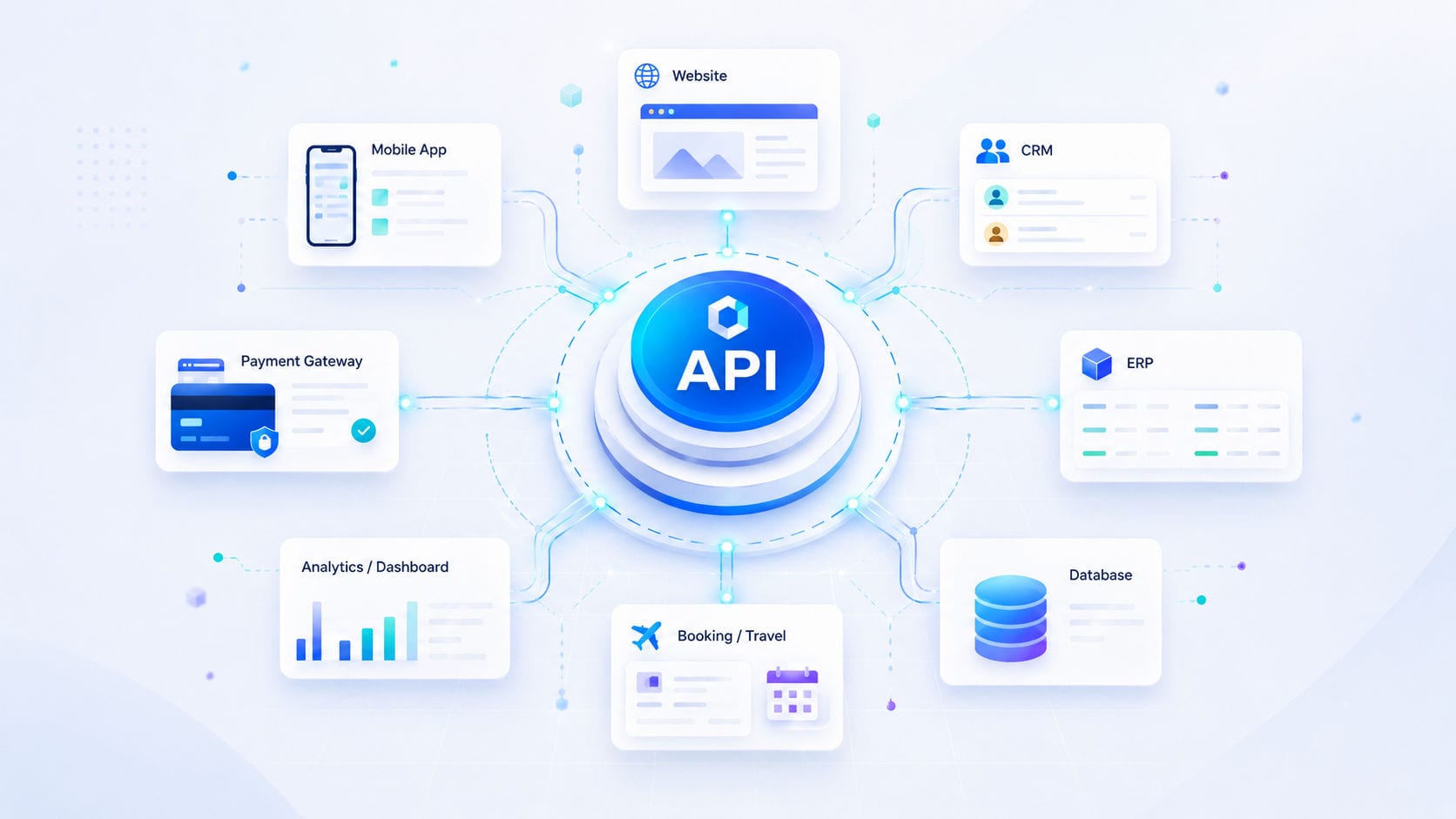
Modern businesses use a wide variety of software tools—from customer relationship managers (CRMs) and enterprise resource planning (ERP) platforms to payment gateways and mobile applications. When these systems live in isolation, teams waste valuable hours manually moving data. This slow process introduces errors, delays operations, and creates duplicate work.
API integration solves this problem by serving as the secure connection layer that allows distinct software systems to communicate and share data automatically.
By building robust APIs, your business can automate manual handoffs, eliminate data silos, and establish a unified digital infrastructure.
1. Streamlining Financial Operations: Payment Gateway Integration
A secure, automated checkout flow is essential for customer trust and cash flow speed. Payment APIs do more than just process credit cards—they connect your frontend sales interfaces to your backend accounting systems.
Transaction Verification: Instantly verifying payments and updating order statuses.
Automated Accounting: Triggering invoice generation and updating revenue metrics in real-time.
Customer Notifications: Sending automatic receipt emails and dispatch updates the second a payment clears.
Explore our services for secure Backend & API Development.
2. Unifying Data: CRM and ERP Integrations
As your operations scale, maintaining scattered records across different tools leads to errors. Connecting your client-facing website with your core business database ensures a single source of truth.
Lead Capture: Routing inquiries from website forms, landing pages, and marketing ads directly into your CRM.
ERP Unification: Syncing sales records, customer history, task assignments, and financial reports between departments.
Process Automation: Triggering automated task creation and team alerts when a deal moves to a new stage.
3. Connecting Travel & Booking Platforms
For travel agencies and booking-heavy businesses, API integration is the engine behind daily operations. Without it, managing live inventory is virtually impossible.
GDS & Supplier Connectivity: Linking directly to airline GDS platforms and hotel suppliers for real-time ticket availability.
Unified Booking Engines: Permitting customers to search, book, and pay across multiple vendors on a single portal.
Agent Portals: Synced tools that calculate commissions, manage supplier invoicing, and generate travel itineraries automatically.
4. Powering Mobile Companion Apps
A mobile app is only as strong as its backend communication. To provide a fast, stable, and responsive user experience, mobile apps rely on dedicated API layers.
A secure app-backend API manages:
User Accounts: Handling secure logins, social sign-ons, and role permissions.
Real-Time Synchronicity: Pushing live updates, chat messages, and order statuses between devices.
Offline Syncing: Buffering user actions offline and updating the central database when a connection is restored.
5. Driving Decisions with Business Intelligence Dashboards
Leadership teams need real-time data to make fast, accurate decisions. Custom dashboards pull data from different sources to give you a complete look at your business operations.
Consolidated KPIs: Aggregating sales, marketing, operations, and support metrics into a single screen.
Automated Reporting: Removing the need for teams to manually compile weekly spreadsheet reports.
Anomaly Detection: Flagging sudden spikes in operational costs or drop-offs in sales pipelines.
Technical Security: Protecting Your Data Pipelines
Connecting systems requires robust security measures to prevent data breaches. Every API we build is designed with multi-layered defenses:
Authentication & Authorization: Utilizing secure protocols like OAuth2 and JWT (JSON Web Tokens).
Rate Limiting & Throttling: Preventing malicious system overload and abuse.
Input Validation: Protecting your core databases from SQL injection and cross-site scripting (XSS) risks.
Building a Scalable Digital Infrastructure
API integrations make your business future-proof. As your company grows, you can easily swap out outdated tools or connect new software to your core system without having to rebuild the entire codebase.
A custom-built API layer is the hidden foundation that makes modern business automation possible.
Ready to connect your software systems and automate your business workflows? Let’s design your system blueprint through our Guided Discovery Intake or contact the engineering team at Motive Solutions Contact.