
Custom E-Commerce vs Shopify vs WooCommerce: Which Is Right for Your Business?
Compare custom e-commerce development, Shopify and WooCommerce based on cost, flexibility, scalability, ownership, integrations, maintenance and long-term growth.
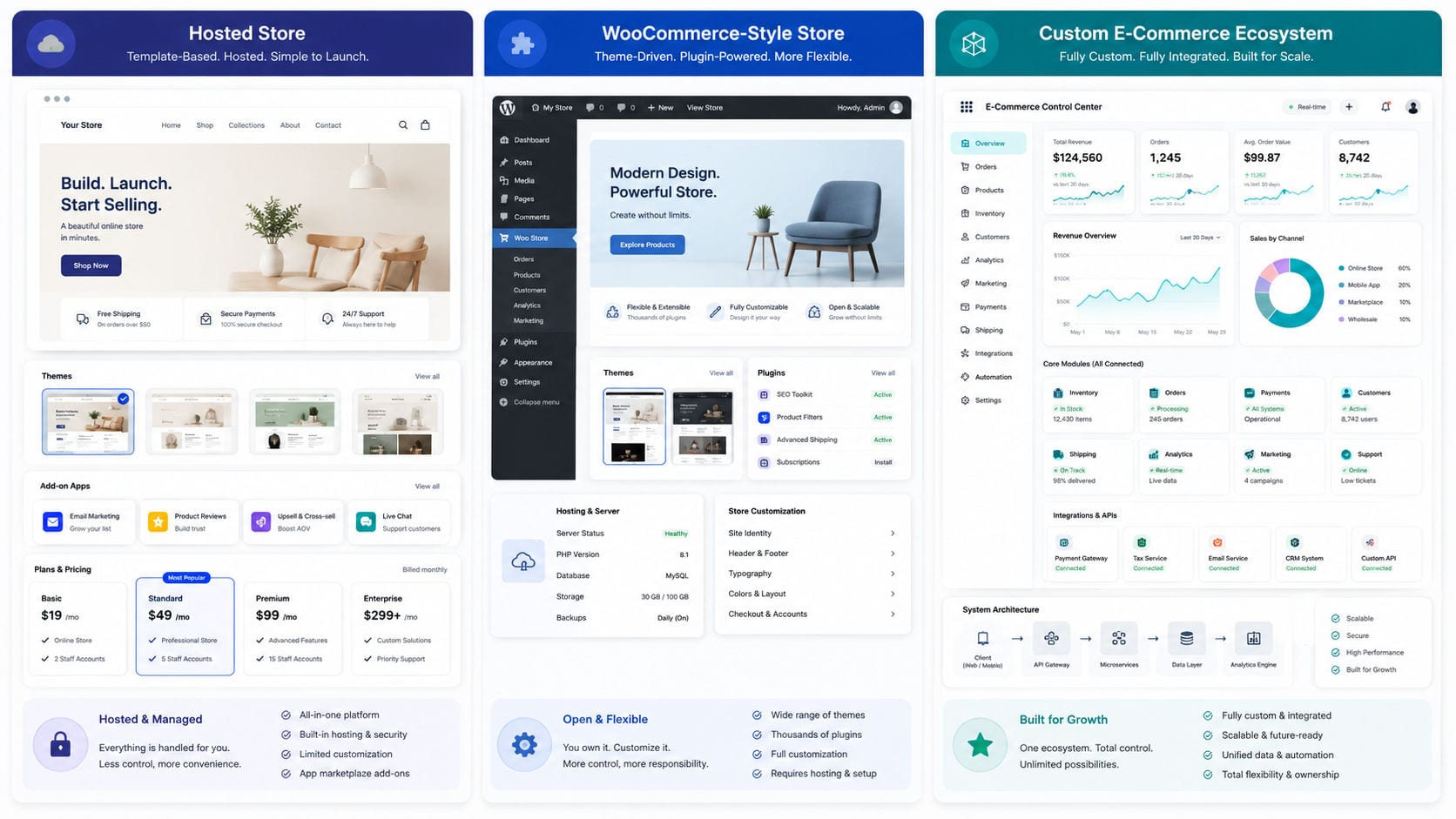
Custom E-Commerce vs. Shopify vs. WooCommerce: Which Is Right for Your Business?
Choosing the right e-commerce platform is one of the most critical operational decisions a retail, wholesale, or product-based enterprise can make. The platform you select serves as the transactional engine of your business, dictating how inventory is synchronized, how customers experience your brand, how securely payments are processed, and how seamlessly your digital commerce operations integrate with your broader enterprise systems.
Product leaders typically evaluate three distinct paths:
Engineering a custom, proprietary e-commerce platform.
Deploying a hosted storefront utilizing Shopify.
Creating a WordPress-based commerce system using WooCommerce.
While Shopify and WooCommerce offer pre-built frameworks for launching online storefronts, custom e-commerce engineering provides unrestricted control over the user experience, proprietary business logic, systems integration, and technical architecture.
None of these approaches is universally applicable. The optimal choice depends on your product complexity, transaction volume, operational workflows, budget constraints, engineering capabilities, and long-term systems roadmap.
What Is Custom E-Commerce Development?
Custom e-commerce development involves designing and engineering a proprietary digital commerce platform from the ground up, tailored precisely to the operational workflows of an enterprise.
Rather than adapting your business operations to fit the rigid templates of a commercial platform, custom engineering structures the storefront, administrative backend, product databases, and system integrations directly around your operations.
A custom-engineered platform is designed to handle complex systems such as:
Advanced product information management (PIM) and dynamic category routing.
Multidimensional product attributes, configurations, and variations.
Segmented customer account portals (B2B, B2C, D2C).
Dynamic, contract-specific, and volume-based pricing structures.
High-performance, optimized shopping carts and single-page checkouts.
Direct, multi-processor payment gateway integrations.
Unified order routing and fulfillment management.
Multi-location, real-time inventory control.
Supplier and dropshipping automation portals.
Dynamic delivery routing and regional carrier integrations.
Automated return, exchange, and refund pipelines.
Rules-based marketing engines, promotions, and loyalty programs.
Real-time operational dashboards and BI reporting.
Native mobile commerce applications using shared backends.
Dedicated wholesale (B2B) bulk ordering environments.
Multi-brand and multi-location system management.
Businesses with specialized operational models can leverage custom e-commerce development to build a platform that matches their exact logistics, customer types, and distribution networks.
What Is Shopify?
Shopify is a fully hosted, Software-as-a-Service (SaaS) e-commerce platform designed to let businesses run online stores without managing the underlying technical infrastructure.
Store owners construct their storefronts by selecting pre-made templates, adding apps from a curated marketplace, and utilizing Shopify’s managed checkout.
Shopify provides a bundled system that includes:
Cloud hosting and content delivery network (CDN) management.
Standardized product and collection management.
Hosted shopping cart and optimized checkout pipelines.
Standard customer account registration.
Core order management and shipping label generation.
A library of customizable storefront themes.
An ecosystem of third-party application integrations.
Built-in storefront analytics and sales reporting.
Automated security patches and core platform updates.
Shopify is suitable for companies seeking to launch rapidly and operate within a standardized online retail framework. It removes the responsibility of server provisioning, database optimization, and core security updates.
However, organizations using Shopify must operate within the platform's API limitations, subscription structures, transaction fees, and custom development constraints.
What Is WooCommerce?
WooCommerce is an open-source, customizable e-commerce plugin built specifically for the WordPress content management system (CMS).
It extends WordPress by injecting product, cart, checkout, payment processing, and order management tables directly into the website's database.
A typical WooCommerce implementation combines:
The WordPress content management system.
Open-source product and category catalogs.
Theme-based visual layouts.
An extensive ecosystem of open-source plugins.
Flexible cart and checkout configurations.
Modular payment gateway integrations.
Basic customer accounts and order management.
Search engine optimization (SEO) plugins and controls.
WooCommerce is a common choice for organizations that already manage their digital presence on WordPress or require greater database and code-level ownership than hosted SaaS platforms allow.
However, the enterprise remains fully responsible for server hosting, database tuning, core software updates, security protocols, and plugin compatibility.
Custom E-Commerce vs. Shopify vs. WooCommerce
The fundamental differences lie in the balance between engineering control, operational speed, and technical responsibility.
Shopify manages the technical foundation but restricts how deeply you can customize the database, core checkout, and backend business logic.
WooCommerce offers high code-level flexibility within the WordPress framework, but places the burden of security, performance optimization, and host management on your team.
Custom E-Commerce provides complete architectural ownership, allowing you to design a platform around your exact operational workflows, though it requires a higher initial investment and dedicated engineering support.
1. Launch Speed
Shopify
Shopify is designed for rapid deployment. Because the hosting infrastructure is pre-configured and the admin panel is ready-made, standard stores can launch within weeks by selecting a template, uploading products, and configuring native payment processors.
WooCommerce
WooCommerce can also support relatively quick launches, particularly for businesses with existing WordPress sites. However, deployment timelines are longer due to the need for server provisioning, database setup, theme development, plugin configuration, and performance optimization before going live.
Custom E-Commerce
Custom engineering takes longer because the platform is designed, built, and tested specifically for your business. The development cycle includes detailed business analysis, custom UI/UX design, database structuring, frontend engineering, and system testing. This initial time investment is designed to pay off in long-term operational efficiency and scalable growth.
2. Initial Cost and Total Cost of Ownership (TCO)
Shopify
Shopify offers low barrier-to-entry pricing, but costs scale with your business. Long-term costs include recurring monthly subscription fees, transaction fees if not using their proprietary processor, premium theme licenses, and monthly subscription costs for third-party apps required to run essential business functions.
WooCommerce
WooCommerce itself is free, open-source software, but running a production-grade store involves substantial operational costs. You must budget for high-performance hosting, premium plugin licenses, custom developer support, security monitoring, automated backup services, and performance tuning.
Custom E-Commerce
Custom development requires a larger upfront capital allocation because you are investing in a proprietary asset. The budget covers systems architecture, custom UI/UX design, database engineering, backend development, integrations, and quality assurance. Over time, a custom platform can lower your total cost of ownership by eliminating recurring transaction fees, SaaS markups, and reliance on third-party app subscriptions.
3. Design and Brand Control
Shopify
Shopify offers structured themes that provide a clean baseline, but customization is bound by the theme's architecture and Shopify’s Liquid templating engine. Creating highly unique user journeys or advanced interactive layouts often requires custom theme development or complex headless commerce architectures.
WooCommerce
WooCommerce offers high visual flexibility through WordPress themes and page builders. However, stacking visual page builders and heavy styling engines can slow down page speeds and lead to layout breaks when updates are applied.
Custom E-Commerce
Custom development provides absolute design and brand control. Every user interface element, page transition, and checkout step is tailored to your brand positioning, product presentation, and conversion goals.
Our UI and UX design services ensure your custom storefront is optimized for conversion, brand loyalty, and accessibility across all screen sizes.
4. Product Catalog Complexity
Shopify and WooCommerce
Both platforms handle standard retail catalogs (with basic variables like size and color) effectively out of the box. However, managing complex catalogs on these platforms often requires installing heavy third-party plugins that can slow database queries and fragment product data.
Custom E-Commerce
A custom platform is engineered directly around your specific product data structures. This is critical for businesses that require:
Multidimensional variations (e.g., pricing based on material, width, and weight).
Configurable products, custom builds, or modular bundles.
Dynamic wholesale (B2B) pricing tiers and customer-specific price sheets.
Multi-warehouse inventory synchronization and regional product availability rules.
Industrial compatibility matrices (e.g., verifying that a spare part matches a specific machine model).
5. Checkout Flexibility
Shopify
Shopify offers a standardized, highly optimized checkout flow designed for high conversion. However, customizing the checkout logic, styling, or fields is restricted on standard plans, limitating your ability to run complex transaction models.
WooCommerce
WooCommerce allows checkouts to be customized using plugins or custom code. However, modifying the checkout with multiple plugins increases the risk of conflicts, failed payments, and slow page loads during peak traffic.
Custom E-Commerce
Custom engineering allows you to design a transactional pipeline built for your specific sales model. A custom checkout can support:
Single-page checkouts designed for mobile conversion.
B2B workflows, including purchase orders, deposits, and credit term authorizations.
Dynamic tax calculations, custom shipping carrier rules, and delivery scheduling.
Subscription billing, recurring payment plans, and split-payment processing.
Instant checkout pathways for returning, authenticated users.
6. Payment Gateway Integrations
Shopify and WooCommerce
Both platforms support standard processors (such as Stripe or PayPal) through standard plugins. However, integrating lesser-known regional processors, bank-direct payments, or complex split-payment APIs can be difficult and may incur platform transaction penalties.
Custom E-Commerce
A custom platform utilizes a secure backend and API development architecture to connect directly with your preferred payment processor. This allows you to negotiate custom processor rates, integrate localized payment methods, support wholesale credit accounts, and manage multi-merchant payouts.
7. Inventory and Order Management
Shopify and WooCommerce
These platforms provide basic dashboards to track stock levels and fulfill orders from a single location. As fulfillment grows to include multiple stores, third-party logistics (3PL) providers, or complex return workflows, these native features can become bottlenecked, requiring external inventory software integrations.
Custom E-Commerce
Custom engineering can unify your order management, inventory control, and supplier communications into a single, automated operational system. This allows you to manage:
Multi-warehouse routing, automatically assigning orders to the closest facility.
Real-time supplier feed integrations and automated drop-shipping pipelines.
Automated inventory synchronization across web, mobile, and physical locations.
Backorder queuing, partial shipments, and automated return processing.
8. Third-Party Integrations
Shopify and WooCommerce
Both platforms offer large plugin marketplaces. While this makes it easy to add simple features, relying on dozens of third-party plugins creates a fragile ecosystem where an update to one plugin can break another.
Custom E-Commerce
Custom platforms utilize a clean, centralized API gateway to communicate with external systems. Integrations with your ERP (Enterprise Resource Planning), CRM (Customer Relationship Management), warehouse management systems, and accounting platforms are engineered as core platform features. This ensures fast, secure, and reliable data synchronization without the risk of third-party plugin conflicts.
9. Scalability
Shopify
Shopify handles high traffic spikes well because it is built on managed infrastructure. However, scaling your business on Shopify means operating within their structural limitations and paying higher transaction fees and subscription tiers as your volume grows.
WooCommerce
WooCommerce scalability depends on the quality of your hosting, database optimization, and caching. As your catalog, customer base, and order volume grow, WooCommerce databases can become bloated, leading to slow page loads and cart abandonment if not managed by a specialized engineering team.
Custom E-Commerce
Custom platforms are engineered for long-term scalability. By decoupling the frontend from the backend (headless architecture) and using optimized databases, custom platforms can handle millions of SKUs and high transaction volumes. True scalability requires careful design of your databases, APIs, caching layers, and cloud infrastructure.
10. Technical Ownership and Platform Control
Shopify
Shopify is a hosted SaaS platform. You own your brand and customer data, but you do not own the underlying software. You must operate within Shopify’s terms of service, pricing updates, and platform changes.
WooCommerce
WooCommerce offers database-level ownership. You can host the application on any server and modify the code as needed. However, you remain dependent on the WordPress update cycle and the developers of the third-party plugins you use.
Custom E-Commerce
Custom development provides complete technical ownership. The source code, databases, hosting environments, and feature roadmap are proprietary assets owned by your business. This level of control is crucial for enterprises where digital commerce technology is a core competitive advantage.
11. Maintenance and Long-Term Operations
Shopify
Shopify manages core server maintenance, security patches, and database optimization. Your team’s maintenance tasks are limited to theme updates, app configurations, and content management.
WooCommerce
WooCommerce requires active technical maintenance. Your team must manage WordPress core updates, WooCommerce plugin updates, PHP version compatibility, server backups, security monitoring, and database cleaning to prevent performance degradation.
Custom E-Commerce
Custom platforms require planned technical maintenance, but resources are focused on monitoring your private servers, optimizing databases, maintaining APIs, and adding new features, rather than managing a web of third-party plugin updates.
12. Search Engine Optimization (SEO)
Shopify
Shopify includes standard SEO controls, but limits custom URL routing and technical file modifications (such as altering the robots.txt or nesting page structures).
WooCommerce
WooCommerce provides deep SEO flexibility through WordPress's content management system and plugins. This allows you to customize metadata, XML sitemaps, and URL structures.
Custom E-Commerce
Custom development allows you to design your technical SEO architecture to match your search strategy. You have control over sitemap generation, structured schema data, page speed performance, mobile rendering, and custom URL structures.
13. Security
Shopify
Shopify manages PCI compliance, SSL certificates, and server protection, reducing the security burden on your internal team.
WooCommerce
WooCommerce security is the responsibility of the store owner. Because WooCommerce stores rely on third-party plugins, outdated or poorly written plugins can introduce vulnerabilities that expose customer and transaction data.
Custom E-Commerce
Custom systems are built using secure coding standards, limiting the risk of generic exploit scripts. Security measures are built directly into the system, including:
Direct, tokenized payment processing (reducing PCI compliance requirements).
Secure, role-based access control (RBAC) for administration tools.
Encrypted database storage and API validation.
Secure authentication protocols and active server monitoring.
14. Business Reporting and Analytics
Shopify and WooCommerce
Both platforms provide standard sales dashboards. However, generating custom reports (such as tracking product profit margins, customer lifetime value across channels, or supplier performance metrics) often requires exporting data to spreadsheets or paying for external BI tools.
Custom E-Commerce
Custom platforms connect your transactional data directly with dashboard and analytics development systems. This allows you to generate custom, real-time reports based on your actual business KPIs, helping you make data-driven operational decisions.
When Is Shopify the Better Choice?
Shopify is the recommended architecture when:
Your business needs to launch a storefront quickly.
Your product structure fits within standard retail parameters (variants like size/color).
You want to minimize internal technical maintenance and server administration.
Pre-built themes and app integrations meet your operational requirements.
Standard subscription and transaction pricing fit your business model.
You do not require complex, proprietary business logic or ERP integrations.
When Is WooCommerce the Better Choice?
WooCommerce is the recommended architecture when:
Your enterprise already operates its marketing site on the WordPress CMS.
Content marketing and dynamic media are central to your customer acquisition strategy.
Complete database and hosting ownership is preferred over hosted SaaS platforms.
Your internal team has WordPress development and server management experience.
The product catalog remains within standard e-commerce complexity limits.
You require deep design and SEO customization within a modular ecosystem.
When Is Custom E-Commerce the Better Choice?
Custom e-commerce development is the recommended architecture when:
Your transaction model is unique (such as B2B portals, subscription models, or marketplaces).
Your product catalogs involve complex configurations, variations, or custom calculations.
You need to connect multiple sales channels, warehouses, and fulfillment networks.
Your store must integrate directly with internal ERPs, CRMs, or legacy databases.
You want to eliminate transaction fees and SaaS subscription markups.
You require complete ownership of your technology stack, database, and source code.
Custom pricing structures, contract accounts, and quotation workflows are required.
Organizations with these operational requirements can explore our e-commerce and digital business solutions.
Can a Business Start With Shopify or WooCommerce and Migrate Later?
Yes. Many growing businesses launch on hosted or template-based platforms to validate their product-market fit, migrating to custom systems as their operational complexity outgrows standard software limitations.
Common triggers for custom migration include:
Rising subscription costs for apps needed to keep the store running.
Performance issues, slow loading speeds, and database bloat.
Difficulty managing complex, multi-warehouse inventory.
The need to connect custom ERPs, internal systems, or proprietary software.
The addition of a wholesale (B2B) channel alongside retail (B2C) sales.
Migration requires planning to protect your customer database, order history, product data, and search engine rankings (SEO) through structured 301 redirect management.
Questions to Ask Before Choosing
To guide your architectural decision, review these questions with your team:
Catalog Complexity: How many SKUs do we manage, and how many dynamic variations do they require?
Sales Channels: Do we sell direct-to-consumer, wholesale to businesses, or both from a single inventory?
Integration Needs: What internal software systems (ERP, CRM, inventory, accounting) must sync with this platform in real time?
Checkout Customization: Does our checkout process require custom calculations, credit checks, or delivery scheduling?
Operational Costs: What will our subscription, transaction, and third-party app fees total over a three-to-five-year period?
Technical Ownership: Is complete control over our transactional code and customer data a strategic priority for our business?
Final Decision
Shopify provides a fast, hosted route to online selling, best for standard retail models and rapid GTM timelines.
WooCommerce offers visual flexibility and database access within the WordPress ecosystem, suitable for content-driven brands with technical support.
Custom E-Commerce provides complete control over your customer experience, database design, backend integrations, and operational scalability, making it the right choice for complex business models.
Build an E-Commerce Platform Around Your Business
Motive Solutions provides e-commerce development services for retailers, wholesalers, product brands, and digital business systems.
We design and engineer product catalogs, B2B portals, shopping checkouts, payment integrations, inventory systems, and business reporting tools. Our services are backed by custom software development, custom UI and UX design, and high-performance backend and API development.
Explore our e-commerce and digital business solutions to plan a commerce system built around your business goals and long-term growth.